 1050
1050
For decades, U.S. military strategy has been built around absolute dominance at sea and in the air. Washington has long portrayed itself as the world’s unrivaled naval and aerial power. That assumption, however, is increasingly detached from reality. Leaked Pentagon documents and public remarks by the U.S. Secretary of Defense now openly acknowledge a sobering conclusion: in virtually every simulated war scenario against China, the United States loses. This admission is not a marginal concern—it is a strategic alarm bell that American decision-makers can no longer afford to ignore.
At the center of this revelation is a leaked Pentagon document known as the “Overmatch Brief.” In military doctrine, overmatch refers to a condition in which one force possesses decisive superiority in firepower, technology, and tactics over its adversary. The document delivers a stark warning: the United States no longer holds this advantage. China does.
According to the findings outlined in the brief, U.S. forces are defeated across all plausible conflict scenarios with China. Years of war-gaming conducted within the Department of Defense indicate that the People’s Liberation Army is capable of dismantling U.S. defensive and naval formations with alarming efficiency. This represents a profound strategic setback for a military establishment that once assumed technological dominance as a given.
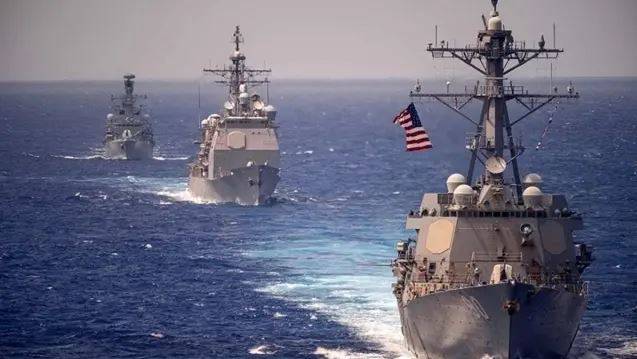
The United States traditionally signals its naval power through the deployment of aircraft carrier strike groups. Yet, in a Taiwan contingency, these very assets become liabilities rather than advantages. From Beijing’s perspective, American aircraft carriers are not symbols of deterrence but high-value, vulnerable targets—effectively floating coffins. China’s investment in hypersonic missile technology has fundamentally altered the balance, enabling it to track and strike U.S. carriers with unprecedented precision.
In practical terms, this means that even a supercarrier such as the USS Gerald R. Ford , carrying more than 5,000 sailors and representing an investment exceeding $13 billion, could be neutralized or sunk at a fraction of that cost. Such a scenario would not merely be a tactical loss—it would signify the collapse of America’s naval strategy in East Asia.
Compounding this vulnerability is China’s growing informational dominance in the region. Superior surveillance, targeting, and command-and-control capabilities would transform the battlefield into a high-casualty environment for U.S. forces, accelerating the breakdown of American defensive lines.
These realities expose several critical dilemmas for Washington. First is the feasibility of direct military engagement. Because U.S. naval assets fall within the range of Chinese missile systems, they would need to operate at distances exceeding 2,000 kilometers from Taiwan to remain survivable. At that range, carrier-based aircraft lack the operational reach to influence the conflict, effectively sidelining the U.S. Navy in a direct confrontation.
Logistics present an equally severe challenge. Taiwan lies close to mainland China, allowing Beijing to sustain its forces with relative ease. In contrast, the nearest major U.S. bases—Japan and Guam—are more than 1,000 kilometers away and themselves vulnerable to Chinese missile strikes. Under such conditions, sustaining U.S. operations becomes deeply uncertain. Assessments suggest that American forces could exhaust their primary munitions stockpiles within seven days, with no clear or reliable mechanism for rapid replenishment.
Ultimately, these findings point to a systemic crisis rather than a budgetary one. America’s complex decision-making structures, flawed procurement policies, and long-standing strategic assumptions have eroded the effectiveness of conventional deterrence. U.S. policymakers increasingly recognize that direct military intervention in a Taiwan conflict would be prohibitively risky.
As a result, Washington appears to be shifting toward an indirect strategy: heavily arming and supporting Taiwan to raise the costs for China, much as it has done in Ukraine against Russia. However, the comparison is imperfect. Advances in technology, logistical realities, and lessons learned from the Ukraine war have reshaped the strategic environment for both sides.
In its current state, the United States lacks the capacity for a sustained direct war with China. In the waters of the Western Pacific, American power resembles more a paper tiger than an unchallenged maritime hegemon. Restoring credible deterrence will require deep structural reform—revising defense strategies, overhauling military-industrial policies, and prioritizing innovation and emerging technologies. Without such changes, the era of unquestioned American military supremacy will continue to fade.
Translated by Ashraf Hemmati from the original Persian article written by Amin mahdavi

Comment
Post a comment for this article