 616
616
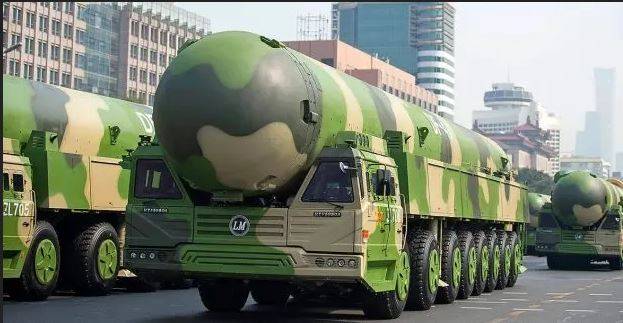
In recent months, a growing number of Western security analysts have sounded the alarm over the rapid expansion of China’s nuclear power. This concern has intensified amid rising tensions between China and Taiwan, turning the issue into a strategic warning signal for the United States. Through massive investment in this critical strategic sector, China is now positioning itself as a direct competitor to Washington, with some analysts predicting that Beijing’s nuclear capabilities may surpass those of both the United States and even Russia in the coming years.
China’s nuclear expansion is unfolding across several key dimensions.
Rapid Growth of Nuclear Capability:
China is significantly increasing its nuclear warhead production capacity through the development and modernization of covert facilities. This capability represents a decisive strategic advantage for China’s armed forces and could play a critical role in future conflicts by safeguarding national sovereignty. Given China’s vast geography, heavy investment in nuclear warhead production allows Beijing to achieve what it views as ultimate security and credible deterrence. With intercontinental ballistic missiles in its arsenal, China now possesses the ability to reach targets anywhere on the planet. This military capability expands Beijing’s strategic freedom of action vis-à-vis Western powers.
Expansion of Critical Nuclear Sites:
Key facilities in Sichuan Province, responsible for warhead component production, explosive testing, and storage, have undergone extensive expansion. China’s main nuclear warhead production sites are advancing at a remarkable pace. From a security standpoint, these facilities are heavily protected by advanced air defense systems, making potential attacks by adversaries increasingly complex and costly.
Shift toward Advanced Deterrence:
Beijing is moving beyond its long-standing doctrine of minimal nuclear deterrence and toward establishing a reliable and operational nuclear strike capability. Historically, China’s nuclear doctrine emphasized second-strike capability. However, changes in Beijing’s security thinking over recent years have reshaped this approach. China is now expanding its first-strike potential, effectively placing itself alongside the United States and Russia as a full-spectrum nuclear power. Should circumstances demand, China would be capable of initiating nuclear conflict — a development that signals a profound shift in Beijing’s role within the Western-dominated international order.
Strategic Ambiguity as Doctrine:
China’s deliberate lack of transparency regarding the size and scope of its nuclear arsenal increases the strategic calculation costs for the United States. By withholding detailed information, Beijing introduces uncertainty that raises the risk of miscalculation by its adversaries. This approach reflects a clear understanding of power politics. China has drawn lessons from recent experiences involving Iran and the International Atomic Energy Agency, where sensitive nuclear data was allegedly accessed by Israel and the United States and later used as a foundation for illegitimate Western military actions. For Beijing, this episode serves as a cautionary tale, reinforcing the logic behind its nuclear ambiguity strategy.
American Psychological Warfare and Media Narratives:
The amplified coverage of China’s nuclear expansion by U.S. media outlets is widely viewed as part of a psychological warfare campaign designed to portray China as an “imminent threat” to the American public and Congress. This narrative aims to justify increased military spending, expand U.S. military presence in East Asia, and politically and economically contain Beijing. Western media, by magnifying the China threat, effectively support the military agenda of the Trump administration, enabling the imposition of costly arms contracts on U.S. allies in East Asia. This continuous media-driven psychological pressure contributes to the construction of apocalyptic scenarios for the Western-led international order.
Conclusion:
The rapid growth of China’s nuclear industry, particularly its military dimension, reflects deep and fundamental changes in Beijing’s approach to international politics. Rising tensions over Taiwan may further expose the scope of these transformations. The Trump administration, however, is expected to approach this challenge with caution. The U.S. National Security Strategy explicitly emphasizes a foreign policy rooted in the Monroe Doctrine, signaling restraint and strategic calculation in Washington’s engagement with China. This caution underscores the reality that China’s nuclear resurgence has altered the global balance of power in ways that the United States can no longer ignore.
Translated by Ashraf Hemmati from the original Persian article written by Amirali Yeganeh
https://www.washingtonpost.com/world/2025/12/28/china-nuclear-warhead-expansion/

Comment
Post a comment for this article